Built for the way Q-commerce actually works.
22 dashboard tabs. 31 connected database tables. One source of truth across forecast, stock, content, ads, and reports.
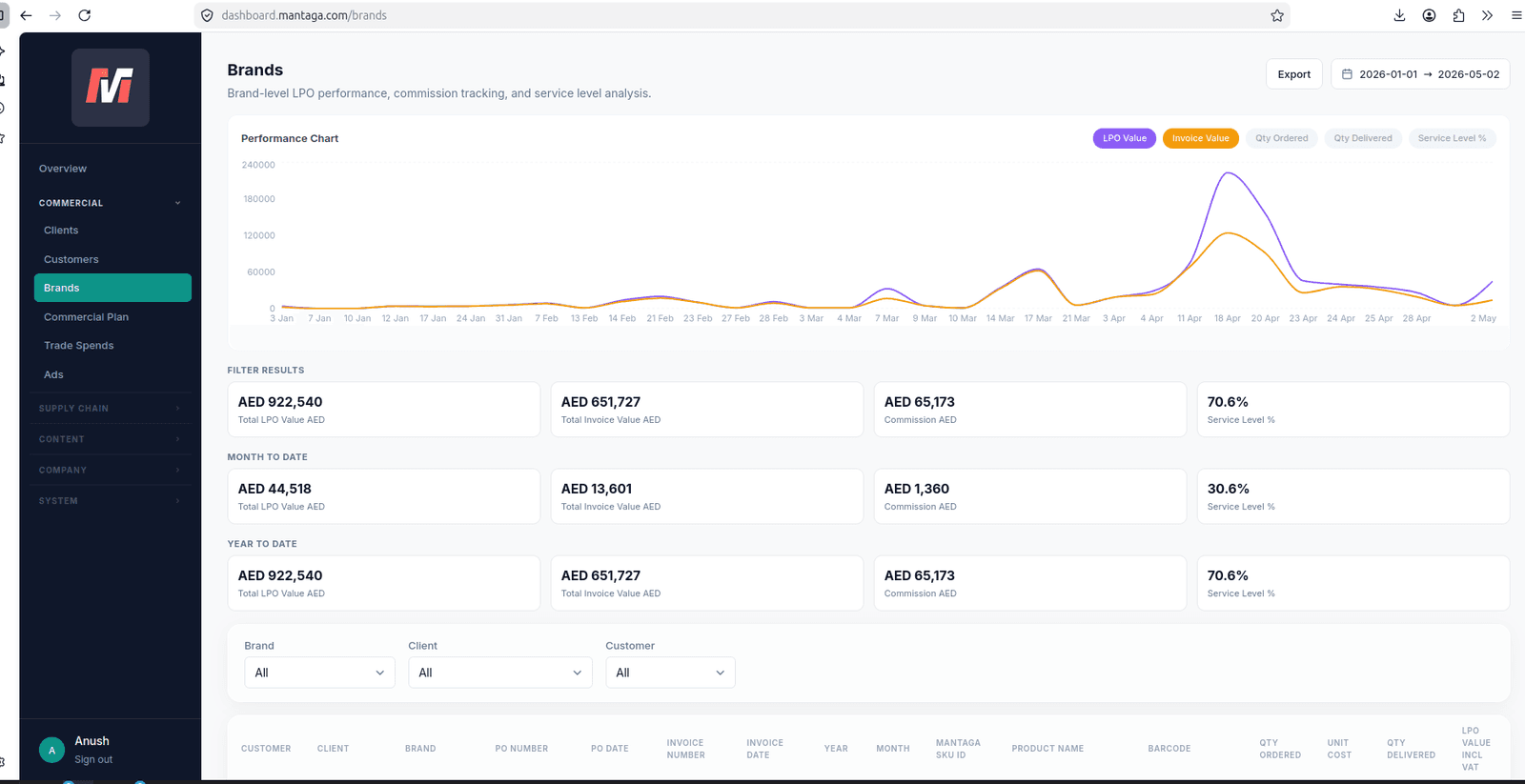
Brand performance, live.
LPO value, invoice value, commission, and service-level % rolled up by brand, client, and customer — and filterable to month-to-date, year-to-date, or any custom window. The exact view we use to spot a service-level drop the morning it happens, not the Monday after.
- LPO value · Invoice value · Commission · Service level % — in one chart
- Brand / client / customer drill-down
- Month-to-date and year-to-date roll-ups
- One-click PDF brand report (was 3–4 hours per brand per month)
Forecasting that catches gaps before stock does.
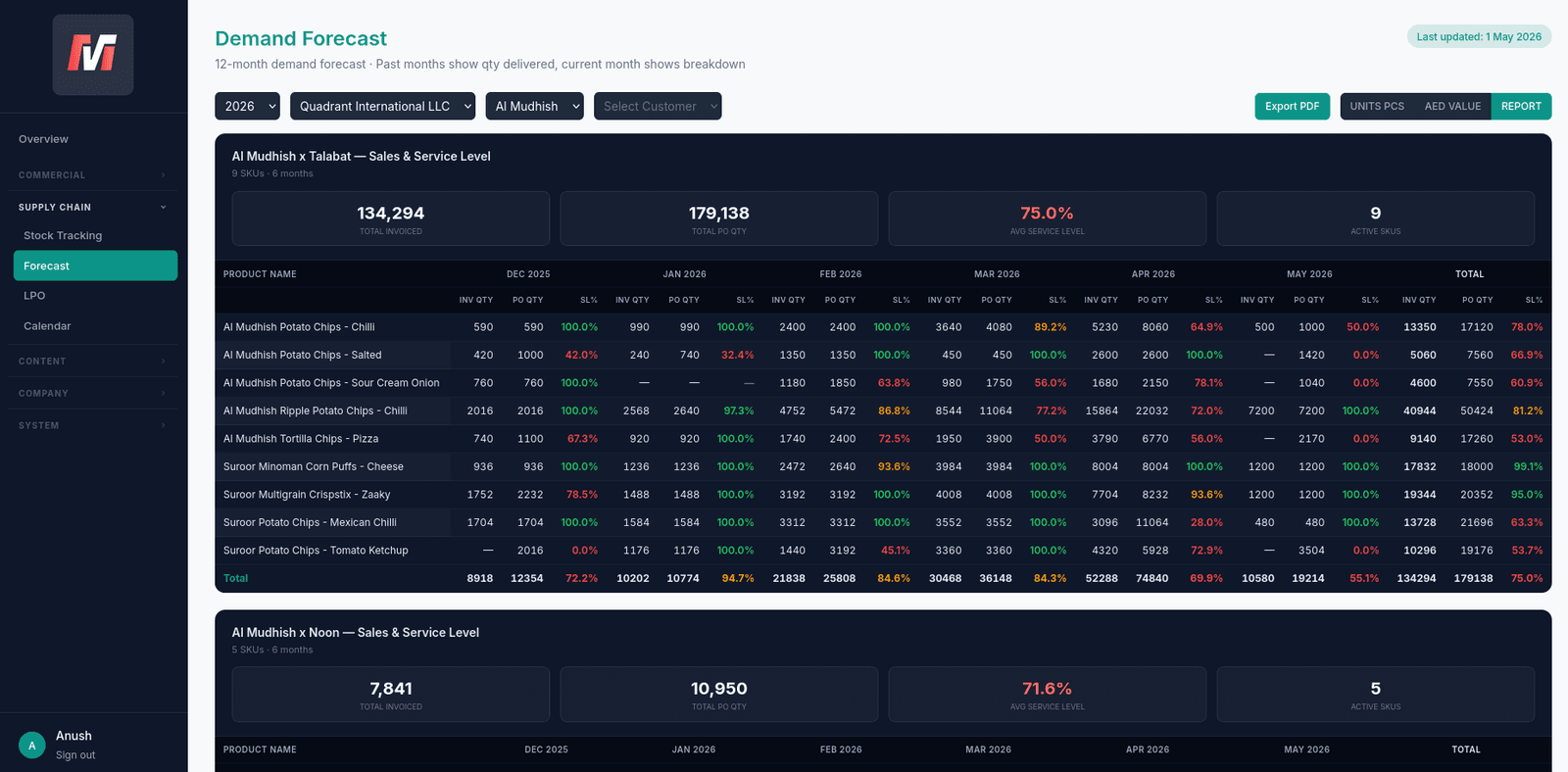
A 12-month rolling forecast per customer-brand pairing, built on a weighted moving average with calendar uplift — re-computed live, per SKU, per platform. Predictive alerts fire at 7 and 14-day cover, so you act on tomorrow's stock-out, not yesterday's.
- Per-SKU INV qty, PO qty, fill % — month by month
- Auto-flagged service level: green >90%, amber 70–90%, red <70%
- Customer × Brand pivots (Al Mudhish × Talabat, × Noon, × Careem…)
- 7 / 14-day predictive cover alerts before MSL gaps hit
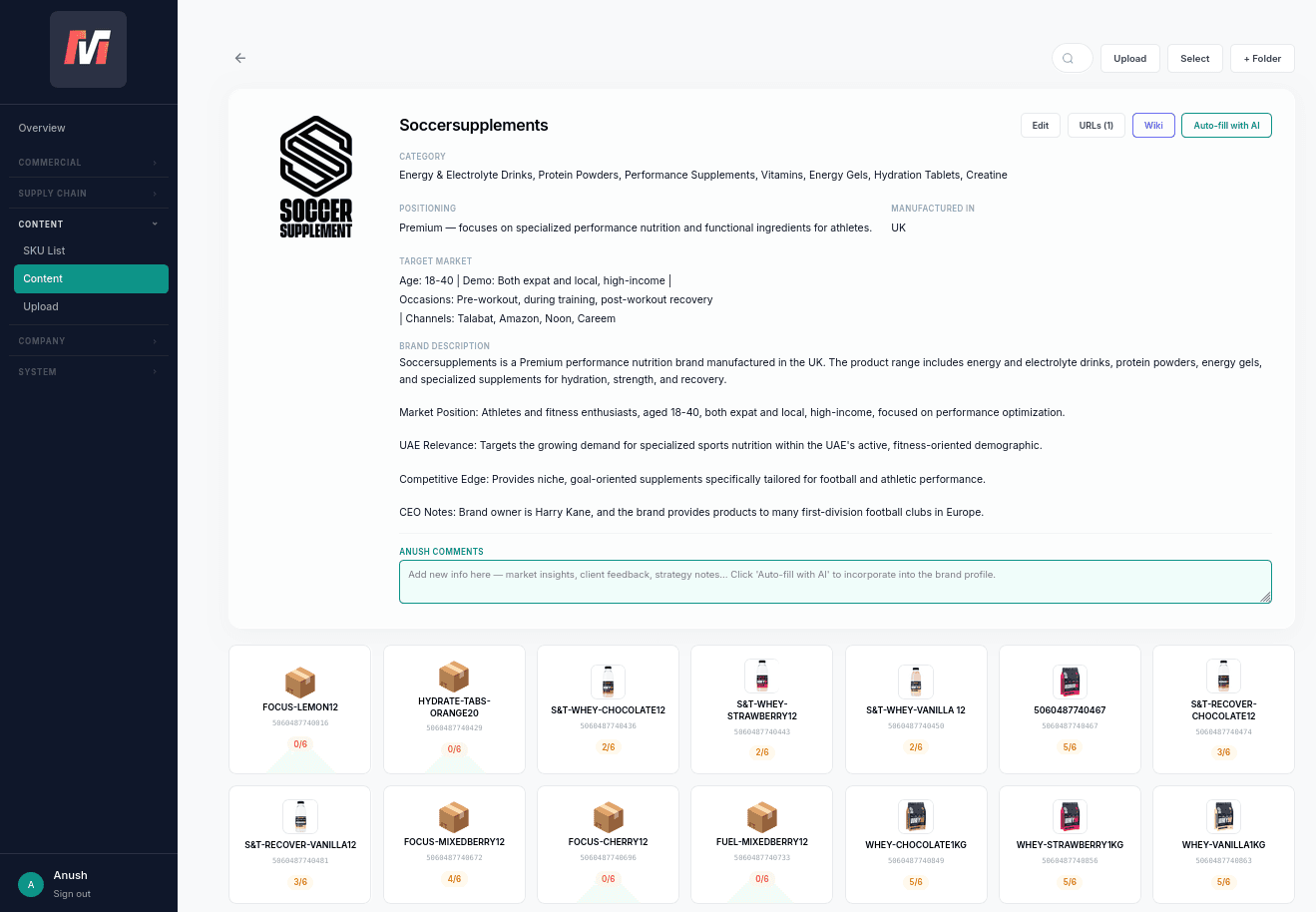
A living brand book — and a content scorecard for every SKU.
Structured profiles for every brand — category, positioning, target market, manufacturing, CEO notes — paired with the live SKU grid. Muse, our content agent, reads packaging images, auto-fills product briefs, and runs a nightly completeness audit so nothing rots in a draft state.
- Structured brand profile: category, positioning, target market, manufacturing
- Per-SKU content scorecard (e.g. 5/6 fields complete)
- Auto-fill from packaging images via local vision LLM
- Nightly content completeness audit — was a quarterly review meeting
Three virtual employees. One unified system.
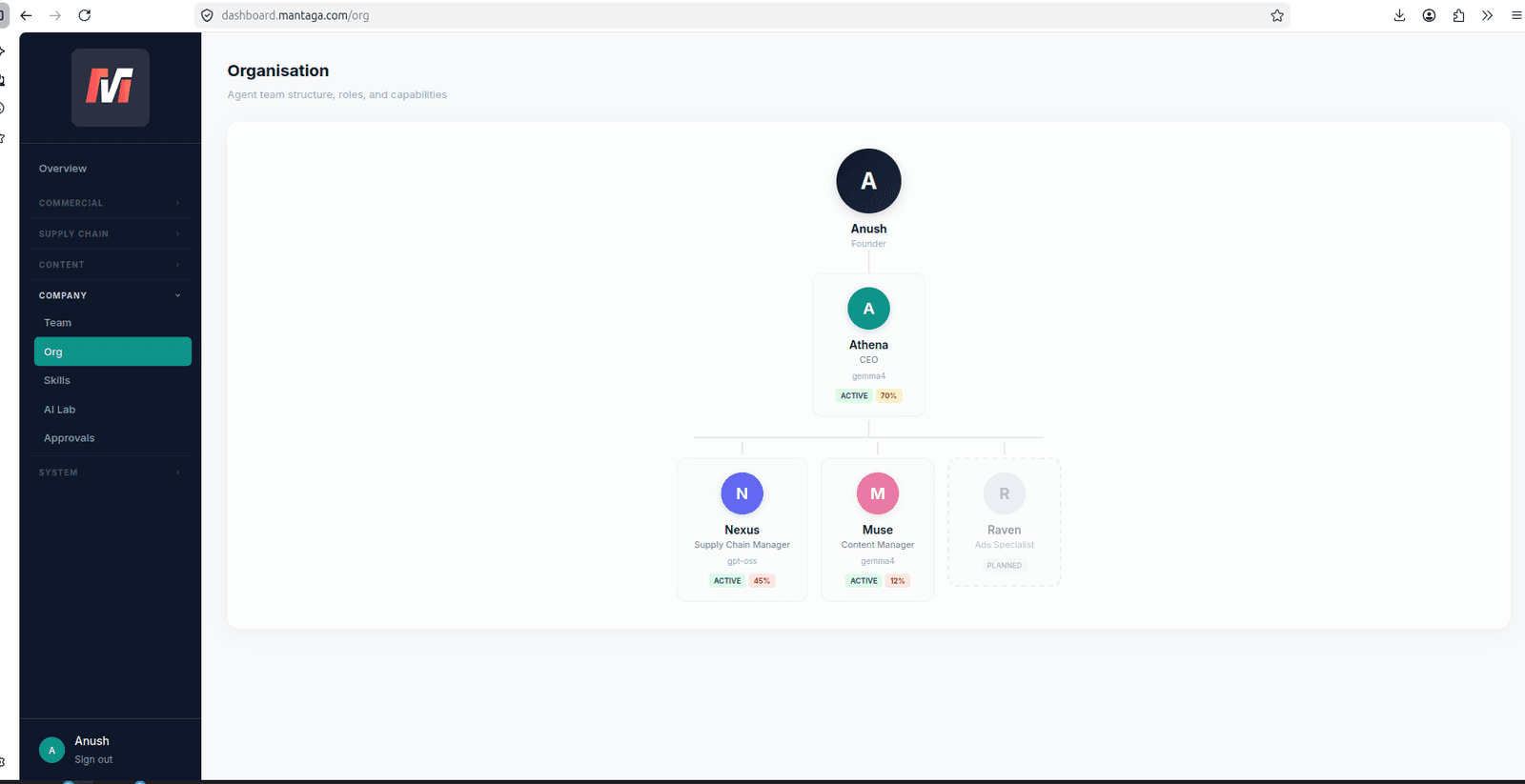
Athena, Nexus, and Muse run as named agents on dedicated AI infrastructure — not chatbot wrappers. They coordinate in a shared operations room, run on schedule (cron-driven, not prompt-driven), and route every meaningful change through a human approvals queue.
- Athena · CEO Agent — daily 6 AM executive brief, evening strategy debates
- Nexus · Supply Chain Manager — 5:30 AM supply chain briefing, Sunday deep reviews
- Muse · Content Manager — packaging-image reading, nightly content audits
- 2,000+ logged agent actions per month · full audit trail